Tibet Protester

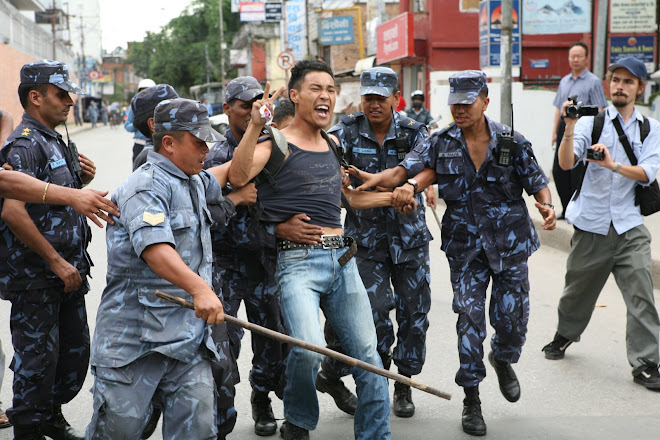
Tibet Protester
A man is taken away by Nepali police during a Tibetan protest outside of the Chinese Embassy in Kathmandu.

World Peace Pagoda

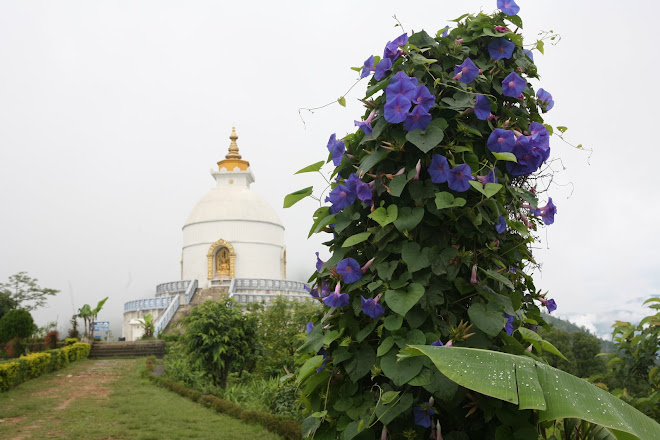
World Peace Pagoda
This is a holy site for Buddhists on top of a hillside over looking the Pokhara Valley, about seven hours west of Kathmandu. It is believed Buddha came to this hilltop to find enlightenment,

Tibetan Flags

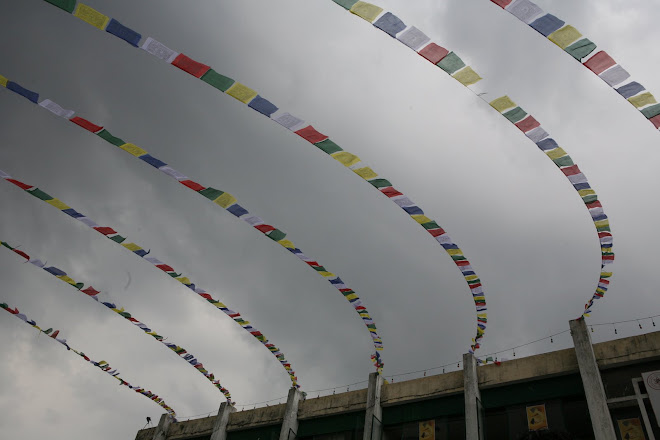
Tibetan Flags
Rows of the flags waved over the film festival on the June 6th. Almost everyday in Kathmandu, Tibetan protesters are arrested outside of the China Embassy.

Wednesday, June 4, 2008

Go with your gut

...I knew this before, but learned it again on the way to work this morning. Running a bit late, I quickly hailed a cab on my block, said "Kantipur Office" which is also the Kathmandu Post, the driver understood and said, "150 rupees?" I said, "No, I only use the metered taxis," and walked away. He chased me down and said, "Okay, fine, I take you there." I reluctantly got in because I was late, but did not feel good about this guy.

We drove about five minutes, to the main, and one of the only stop lights in Ktm, running the red light and weaving through cars, motorbikes and buses. I had been waiting for what was about to happen next for the entire week I have been in Nepal --- an accident. We t-boned a motorbiker directly in his side. I screamed, hit my head on the seat in front of me (this is why I ride in the back and not front, for a seat is better than a windshield) and yelled at the cabby. He yelled back at me and I told him to stop and see if the person was okay. No time for that in Nepal...

Between holding my breath as we past trucks blowing out the blackest smoke/smog/pollution you have ever seen, I wondered if the person we had hit was alright. He didn't fly off the bike, but looked shaken up --- I was too.

Finally after the meter reached 110 rupees, I told him to "Rokeeno!" or "Stop!" and tipped him 2 small rupees, and walked the rest of the way to the office. (F*** that guy I thought to myself!)

On a lighter note, here is my third clip:

State of art education in Nepal: Peaceful protest through art for higher studies

By Tess McEnroe

In a form of peaceful protest, a performance art demonstration was held at the Nepal Fine Arts College on Wednesday afternoon, to shine light on Nepali art students not being able to study art at the Master's Degree level.

Hitman Gurung, an art student at the college, created and directed the piece called “Art. Bridge. Education.” The protest was through art, for art education, and to show the struggle these art students have when they enter the workforce.

“By doing so, perhaps we'll have a practical solution to our problem, and a study can carry on with his study,” said Gurung.

The standard to be hired in the art industry is having at least a four-year program degree, yet this college only has a three-year program. As a result, it is difficult for the students to find employment once they have completed the program. Since there are few proper facilities for a Master's Degree program in Nepal, students are often forced to study abroad to further their art education.

“These students can't go anywhere else after they graduate because there is no Master's Degree available,” said Madan Chitrakar, a temporary faculty member and art writer at the college.

Gurung's piece included about 30 fellow students dressed in smocks, with messages on their backs reading, for example, “This is our future,” and “Can you see me?” Other students and citizens gathered around each of the models writing messages in Nepali and English on their arms, saying, “Let the creators be creative,” and “We want M.F.A. [Master's of Fine Arts] in Nepal,” to name a few.

Both the students and teachers believe that since Nepal has a widely known and respected traditional and folk art community, it is only right to be able to further their study and contribute to the international contemporary art scene.

Tuesday, June 3, 2008

"Is no problem, is fine"

This is a statement I hear at least five times a day in Ktm (**Kathmandu** for those who don't have a common-language-abreviation sense). And no the "is" is NOT a typo. It is simply there instead of "it's."

Nepalis are pretty simple people. This may stem from their mostly Hindi and Buddist religions, but I am still trying to figure out the root of this idea. Although I really do like that mentality, it is slightly frusterating that everyone runs on their own schedule. 

Yes, it is a large cultural difference than us, high-strung, multi-tasking, hyper-tensive Americans. For example, it has taken over 50 hours for my press ID badge to be made. You have to track the person down in charge of making them, and remind them three times, and then maybe it may be done by 5pm today as promised. I have been lucky that on my assignments so far, I haven't needed one, but I cannot imagine not have a credential if I was sent to cover, for instance, a Maoist Party meeting, or the exit of the King from his royal palace.

I was told before I came here, and now I understand first hand, that Nepalis are kind, almost too kind for their and my own good sometimes. There is often too much trust in strangers. Quite a difference from the sometimes guarded personalities we encounter at home in the states. We in America are raised to be very aware and cautious of people we don't know for the most part. I know that is a big hunch, and a possible stereotype, but I think you get my drift.

2nd assignment

Although this assignment was in two languages I didn't understand, I learned soo much in the two hours I was there writing and shooting. I got totally ripped off by a cab driver as well! Ahh you live and learn...

Cartooning class for deaf students

by Tess McEnroe

A cartooning instruction class was held at the National Campus of Balkumari, Lalitpur this Monday for 27 deaf students to introduce them to creative and visual job opportunities in the future.

National Campus Principal, Sarah Giri, a sign language specialist, interpreted for the deaf students as guest lecturer and cartoonist, Yogesh Khapangi, spoke in Nepali. The goal of the class was to give the deaf community an example of a vocational option, and help them see art in different ways.

"We organized this program as a step towards social inclusion for deaf students in academics," said Giri.

The deaf culture is a visual one, according to Giri, and forms of art such as painting and cartooning, for example, give the deaf more advantages in the visual communication world.

Khapangi specializes in cartoons, graphics and illustrations and is also the Vice President of Cartoonists' Club of Nepal (CCON). Giri invited him to lecture because he can be a role model for deaf students and the deaf community. During his hour and a half lecture, Khapangi displayed the basics of how to draw a human figure, and when to use the proper materials, such as sketching pencils and markers.

The students participated, interacted, and got to practice cartooning and drawing techniques with the pencils and sketch books that they were allowed to keep.

"This is not for entertainment, the deaf have enriched my life, so I am trying to enrich theirs," concluded Giri.

Monday, June 2, 2008

My First Assigment: 1st International Mt. Everest Day

I was sent to write a story and shoot photos of a sculpture exhibit of "waste" taken down from the summit of the tallest mountain in the world; Everest. The photo that was chosen was not my favorite but notwithstanding, it was good first assignment. I have never been so excited to cover fluff. At least it is fluff in a different culture and country!

Beautiful waste from Everest

by Tess McEnroe

A sculpture symposium called “A Beautiful Waste” was held yesterday to mark International Mount Everest Day at the Nepal Tourism Board exhibiting pieces of waste taken down by climbers from the summit of Mount Everest.

The exhibit was sponsored by a variety of groups including the Rotary Club Nepal, to put the waste to good use in forms of sculpture that will be constructed by a group of 13 artists by Friday. Sunday was the start of the project and during this week, the artists will use the so-called “waste” to be made into works of art. This project has been awaiting this exhibit since 2005.

Gopal Sunder Lal Kakshapati, the President of the Rotary Club said, “We wanted to do something for the waste and make an eye-opener for people. There is no value in keeping all of this in a room, so it was my idea to turn the waste into something beautiful.”

Chief guests of honor at the opening ceremony included Kali Das Shrestha, a well-known Nepali fine artist, the President of the Nepal Mountaineering Association, Ang Tsering Sherpa and Mahabbur Rehman from Bangladesh.

During this week, the Rotary Club will decide whether to sell the final sculptures, or put them in museums, possibly in Pokhara. The final cost of getting the “waste,” down from the summit will be about $200,000. The artists' materials included everything from metal scraps from a helicopter crash, to combs and shoes, brought down to the Everest base camp.


Saturday, May 31, 2008

First Few Days

So I have never been a huge fan of blogs, but I felt like I should do one while I am in Nepal. Hang in there and hopefully this will be somewhat interesting. I figured its more widespread and faster than email, and a bit more intellectual than Facebook. I will try to post as often as I have the internet....

For those who may not know, I am doing my photojournalism internship at the Kathmandu Post in Kathmandu, Nepal for eight weeks. The paper is printed in English and a Nepali version called Kantipur. I will be working as a staff photographer and writer for the City Post section of the paper mostly. Google the Post if you like and I will also try to post my work on here.

You must also know some background information on Nepal's government status now. After 240 years of monarchy, the country is transforming into a republic before my eyes. I still cannot believe I will be one of the lucky journalists to be covering such a crucial and exciting time in Nepali history. In fact, the day I arrived was the first official day of the republic, and the whole country was on holiday, and the next day the king was told to leave his palace. The government is still very unstable and still in the works. The Maoists, or the Communist Party believe they have control, while about 30 other parties disagree.

After over 30 hours on an airplane, including four layovers, having my luggage lost, and getting over jet lag, I love it here so far. Within my first five minutes in the cab ride from the airport to a little hotel in the tourist district of Thamel, I saw naked children being bathed on the sidewalk, cows and goats chewing their cud in the middle of the street, monkeys jumping from tree to tree, and people and garbage everywhere you look. Although Kathmandu is filthy and extremely polluted, I found the people to be some of the hardest working I have ever seen.

The first advice, and some of the best I have gotten in my entire life is: "Be simple, think simple, and things will work themselves out." Rajendra Acharya told me this. He is the director of Nepali Television (a big job) and a graduate of U of MT's School of Journalism's Master's Program. I have been staying with him and his wonderful family these first few days, and will be for about another week I think. I visited his TV station the other day and watched the news being broadcasted first in Nepali and then in English.

Time is not an issue here. It is like "river time" to me, so I can get used to it. There is barely any punctuality. You never know when the power will be shut off at night for up to 16 hours. It is practically a death wish if you want to cross a street here as well. If you have ever ridden in a Mexican cab, multiply that by 50 and then you will maybe understand how Nepali's drive. These are normal things in Nepal.

The food is obviously also quite different than what a white girl is used to. I am sticking to potatoes, or "alloo," rice and cooked veggies -- no meat (which is goat, buffalo and chicken mostly). I bought Nepali dictionary before I came, but it hasn't been nearly as useful as hearing the language first hand, and I have already learned about ten words and few phrases. Rajendra's sweet daughter, Sanskriti, gives me a quiz everyday, after learning my new "word of the day," and I do the same for her in English. It's a good system. Hopefully by the end of eight weeks I will be able to get around pretty well.

Today is my first day the Post and I am waiting for my boss to get here. I don't start work until noon, which is an adjustment. I am sitting here wondering what my first assignment will be....